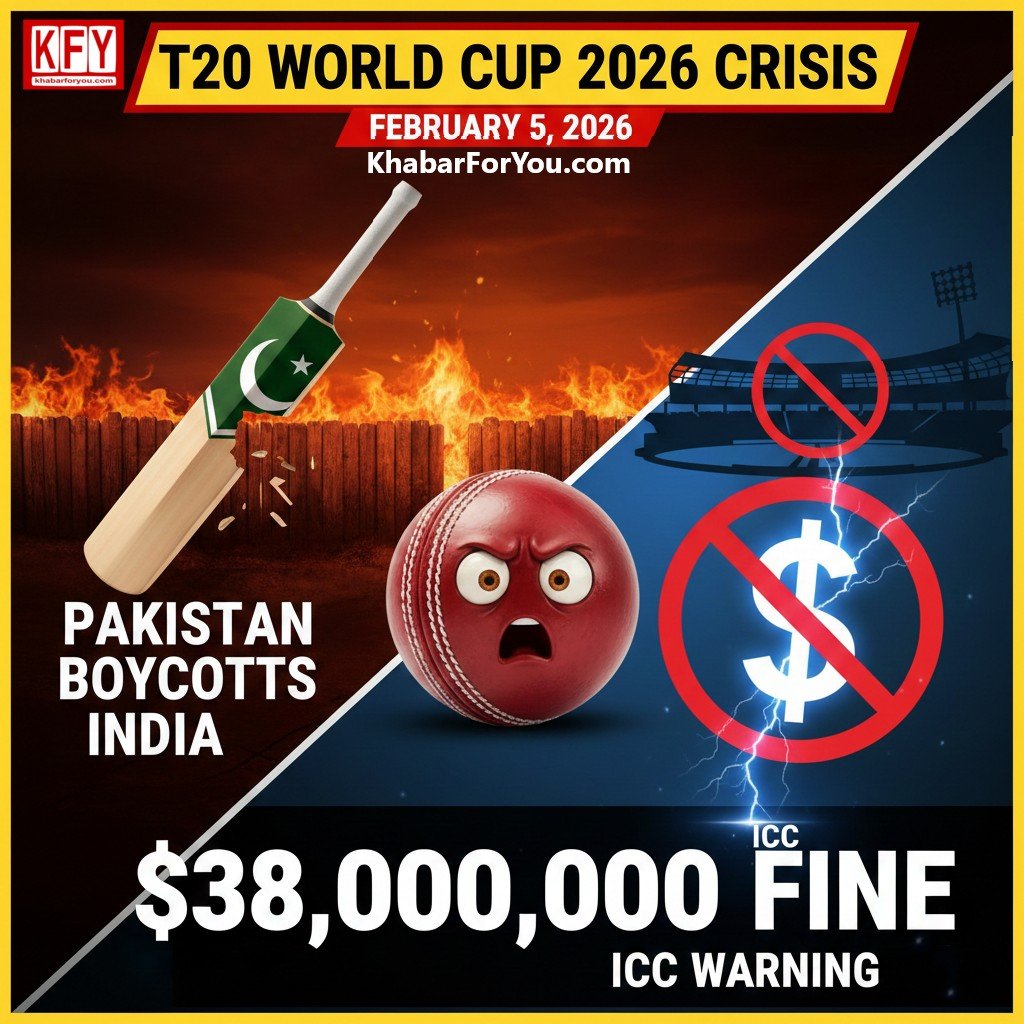
T20 World Cup 2026 Crisis: Pakistan Boycotts India Match | Massive $38M ICC Fine?
- ASHOK KUMAR
- 05 Feb, 2026
- 78540

Email:-AKP00199824@gmail.com
Instagram:-@MR_ASHOK.024

NEW DELHI / ISLAMABAD / COLOMBO - Cricket’s biggest stage has been plunged into an unprecedented diplomatic and financial crisis. Just days before the first ball of the ICC Men’s T20 World Cup 2026 is set to be bowled, the sport finds itself at the mercy of geopolitical maneuvering. Pakistan Prime Minister Shehbaz Sharif has officially endorsed a decision for the national team to boycott its high-octane group-stage clash against India, scheduled for February 15 in Colombo.
The move, framed by Islamabad as a "considered stance" of solidarity with Bangladesh, has sent shockwaves through the International Cricket Council (ICC) and threatens to dismantle the commercial foundations of the global game.
Read More - स्टार हेल्थ इंश्योरेंस को झटका: कोर्ट ने दिलाया ₹2.10 लाख का कोरोना रक्षक क्लेम | Khabar For You
The Catalyst: The Mustafizur Factor and the Dhaka Defiance
The origins of this standoff trace back to early January, beginning not on the pitch, but in the boardroom of the Indian Premier League (IPL). The controversy ignited when the Board of Control for Cricket in India (BCCI) reportedly directed the Kolkata Knight Riders (KKR) to release Bangladeshi pacer Mustafizur Rahman following pressure from domestic political groups.
What started as a franchise selection issue rapidly morphed into a national affront for Dhaka. The Bangladesh Cricket Board (BCB), backed by its interim government, cited "heightened security concerns" and a "hostile environment," refusing to travel to India for their scheduled World Cup fixtures in Kolkata and Mumbai.
Despite frantic negotiations, the ICC stood firm, stating that an independent security assessment found the threat level in India to be "low to moderate." When the BCB refused to budge, the governing body took the radical step of ejecting Bangladesh from the tournament, replacing them with Scotland.
> "We cannot compromise the dignity and safety of our players. If the environment is deemed unsafe by our government, we simply cannot cross the border," a senior BCB official told reporters last month.
Pakistan’s Stance: Solidarity or Strategy?
While most member boards remained silent on the Bangladesh exit, Pakistan emerged as a vocal dissenter. Addressing the federal cabinet in Islamabad on Wednesday, PM Shehbaz Sharif confirmed that while Pakistan would participate in the tournament, it would "not take the field" against India.
"We have taken a very clear stand," Sharif stated. "There should be no politics in sports, yet our neighbors continue to use it as a tool. We stand in complete solidarity with our brothers in Bangladesh who were unfairly excluded. This is a considered decision taken in the interest of regional fairness."
The Pakistan Cricket Board (PCB), led by Chairman Mohsin Naqvi, has confirmed it will follow the government’s directive. The decision is a massive sporting gamble; by forfeiting the match, Pakistan will not only lose two vital points but will also suffer a catastrophic blow to their Net Run Rate (NRR), effectively being recorded as having scored zero runs in 20 overs. This significantly complicates their path to the Super 8s, even if they win their remaining matches against the USA, Namibia, and the Netherlands.
The Financial Abyss: A $38 Million Gamble
The ICC’s response has been uncharacteristically blunt. In a strongly worded statement, the council warned of "serious and long-term consequences" for the PCB. Sources suggest the ICC is considering withholding Pakistan’s annual revenue share - estimated at roughly $35 million to $38 million - to offset potential legal claims from broadcasters.
The commercial stakes are staggering. An India-Pakistan match is the "sun" around which the cricket economy orbits.
Broadcast Valuation:The fixture alone is estimated to generate over $250 million (₹2,000 crore) in global ad revenue and digital engagement.
Broadcaster Pressure: Media giants like JioStar have reportedly already sought rebates, arguing that the absence of the marquee clash constitutes a breach of the tournament’s "value proposition."
Sponsorship Fallout: Global sponsors, who pay premiums specifically for the reach of the Indo-Pak rivalry, are reportedly reviewing "force majeure" clauses in their contracts.
Geopolitical Context: The ‘Double Standards’ Debate
At the heart of Islamabad’s defiance is a sense of historical grievance. PCB officials have frequently pointed to the "double standards" of the ICC regarding the 2025 Champions Trophy. Last year, India refused to travel to Pakistan for that tournament, citing government orders, which forced the event into a "hybrid model."
"When India refuses to play in Pakistan, the ICC adjusts the entire schedule to accommodate them," said former PCB Chairman Ehsan Mani. "But when Bangladesh raises security concerns or Pakistan takes a principled stand, the talk immediately shifts to sanctions. You cannot have one set of rules for the ‘Big Three’ and another for the rest."
The ICC, however, maintains that the situations are not comparable, as the 2026 World Cup is a multi-venue event with established co-hosts, and the schedule was ratified by all members - including Pakistan - months in advance.
Broader Impact: A Rivalry on Life Support
As the Pakistan squad landed in Colombo this week, the atmosphere remained somber. Captain Salman Ali Agha noted that while the players remain focused on the games they *will* play, the uncertainty is a "distraction no professional wants."
Beyond the immediate tournament, the long-term damage to the sport's most famous rivalry could be irreparable. If the boycott proceeds, it marks the first time a team has voluntarily forfeited a World Cup match for political reasons since the 2003 World Cup (when England and New Zealand refused to play in Zimbabwe and Kenya respectively).
**The Risks Ahead:**
1. Isolation:Pakistan risks becoming a "pariah" within the ICC if other boards side with the governing body to protect their own revenue shares.
2. Broadcaster Withdrawal:Future rights cycles could see a significant dip in value if the "crown jewel" of the sport - the India-Pakistan match - is no longer a guaranteed product.
3. Fan Fatigue: The constant intermingling of border politics and cricket is beginning to alienate the younger, global demographic that the ICC is desperate to court.
For now, the R. Premadasa Stadium in Colombo prepares for a match that may never happen. India is expected to follow protocol: arriving at the ground, completing the toss, and waiting for the match referee to formally award the points. It would be a hollow victory for India, a financial disaster for the ICC, and a heartbreaking moment for millions of fans who believe that, for at least 40 overs, the world should be able to look past the border.
Business, Sports, Lifestyle ,Politics ,Entertainment ,Technology ,National ,World ,Travel ,Editorial and Article में सबसे बड़ी समाचार कहानियों के शीर्ष पर बने रहने के लिए, हमारे subscriber-to-our-newsletter khabarforyou.com पर बॉटम लाइन पर साइन अप करें। |
| यदि आपके या आपके किसी जानने वाले के पास प्रकाशित करने के लिए कोई समाचार है, तो इस हेल्पलाइन पर कॉल करें या व्हाट्सअप करें: 8502024040 |
#KFY #KFYNEWS #KHABARFORYOU #WORLDNEWS
नवीनतम PODCAST सुनें, केवल The FM Yours पर
Click for more trending Khabar
Leave a Reply
Your email address will not be published. Required fields are marked *
Search
Category