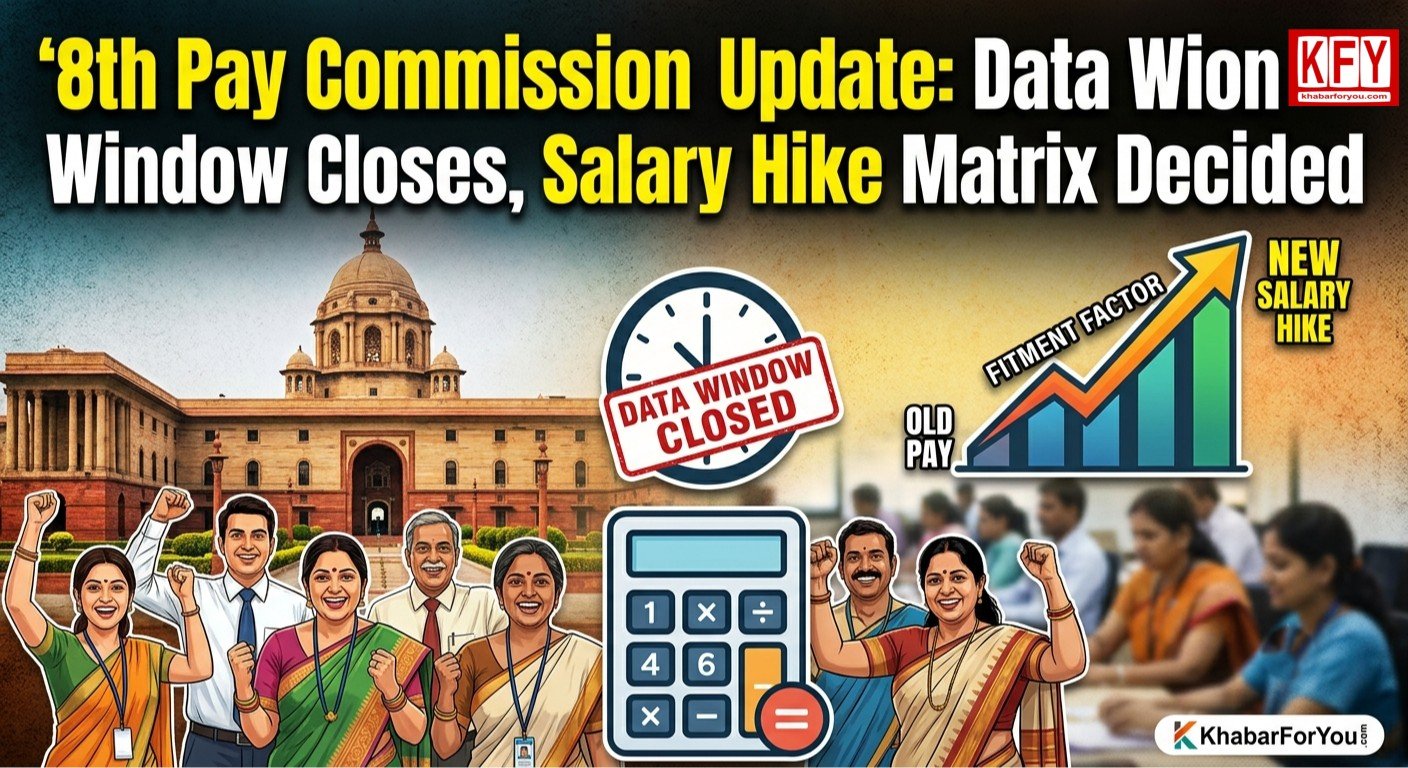
8th Pay Commission Update: Data Window Closes, Salary Hike Matrix Decided | KhabarForYou
- Khabar Editor
- 04 Aug, 2026
- 88128

Email:-infokhabarforyou@gmail.com
Instagram:-@khabar_for_you

NEW DELHI - On the midnight of July 31, a quiet digital milestone slipped past the general public, but across government secretariat offices from South Block to regional union headquarters in Chennai and Chandigarh, the tension was palpable. The 8th Central Pay Commission (CPC) officially shut its online data submission portal, concluding a multi-month exercise where every Union Ministry, central department, and Union Territory administration was mandated to upload detailed records of their organizational machinery.
For over 48 lakh active central government employees and nearly 68 lakh pensioners, the closing of this data window marks a critical shift. The commission, headed by a panel of economic, administrative, and legal experts, moves from passive data gathering to active, high-stakes arithmetic. What hangs in the balance is not merely a routine pay scale recalibration, but a monumental fiscal overhaul that will dictate government wage expenditure, pension liabilities, consumer spending power, and macro-economic stability for the coming decade.
Read More - Phantom Bubbles & Shifting Scores: NEET-UG OMR Discrepancy Claims Reach Supreme Court | KhabarForYou
Inside the Data Upload: What the Ministries Submitted
The deadline for data submission had already seen a high-tension push. Originally scheduled to close on June 30, the portal’s operational window was extended by an additional month to July 31 after several key ministries - including Railways, Defence, and Telecommunications - requested extra time to consolidate vast, decentralized workforce registries.
The uploaded archives represent thousands of pages of granular institutional data. The submissions cover five primary vectors:
1. Detailed Employee Rosters: Comprehensive profiles detailing exact numbers across Group A, B, and C cadres, including technical vs. administrative distributions.
2. Current Pay & Grade Structure: Detailed maps of current pay matrices under the 7th Pay Commission, including existing basic pay bands and running pay scales.
3. Allowance Dynamics: Exhaustive figures on House Rent Allowance (HRA), Transport Allowance (TA), Children Education Allowance (CEA), and specialized risk or operational allowances.
4. Cadre Vacancies: Department-wise vacancy charts that highlight structural understaffing, contractual reliance, and operational bottlenecks.
5. Fiscal Impact Projections: Internal estimates from departments regarding the immediate financial footprint of potential pay revisions.
An official closely connected with the commission's secretariat, speaking on condition of anonymity, noted that the data volume is unprecedented. "We are no longer dealing with simple paper submissions or static reports. The digital portal has synthesized vast data matrices across thousands of sub-cadres. The panel now has a complete operational image of the central public sector workforce."
The Big Demands: Fitment Factor, Pay Scale Mergers, and Basic Salary
While the panel prepares its algorithmic models, employee federations and pensioners’ unions are intensifying their outreach. Primary among their demands is a fundamental revision of the Fitment Factor - the multiplier used to calculate new basic pay from existing scales.
Under the 7th Pay Commission, the minimum fitment factor was established at 2.57, which raised the minimum basic salary from ₹7,000 to ₹18,000 per month. Staff unions, led by joint action committees representing railway workers, defense civilian employees, and postal staff, argue that persistent post-pandemic inflation and real-cost-of-living increases have rendered the current baseline obsolete.
Employee federations are pitching for a fitment factor ranging between 3.0 and 3.68. Should a fitment factor in the upper spectrum be adopted, the baseline minimum pay for entry-level central employees could see a dramatic jump from ₹18,000 to anywhere between ₹50,000 and ₹69,000 per month.
Key demands submitted in worker organization memorandums include:
Basic Pay Recalibration: Raising the entry-level baseline significantly to match modern urban living costs, inflation indexes, and essential commodity pricing.
Pay Scale Rationalization: Merging redundant pay scales in Group B and Group C cadres to eliminate promotional stagnation and administrative friction.
Overhauled DA Mechanism: Modifying the Dearness Allowance (DA) calculation formula to reflect real-time price volatility in food, fuel, housing, and healthcare rather than standard historical averages.
Enhanced House Rent Allowance (HRA): Restructuring HRA tiers to align with sky-rocketing residential rental rates across X, Y, and Z category cities.
Dynamic Pay Mechanism: Introducing a auto-trigger mechanism that updates pay scales dynamically whenever DA crosses the 50% threshold, rather than waiting a full 10 years for a new commission.
Pension and Parity Safeguards: Ensuring absolute pension restoration formulas and health protection schemes for senior citizens and retired defense personnel under the Central Government Health Scheme (CGHS).
Nationwide Outreach: From Delhi Secretariat to Regional Hubs
With data gathering closed, the Commission is launching a comprehensive consultative roadshow. Over the coming weeks, the panel will host formal hearings with union leaders, financial analysts, state delegates, and ministry representatives.
While New Delhi remains the focal point for core administrative hearings this month, official schedules confirm that the commission will conduct on-the-ground consultations in Chennai, Puducherry, and Chandigarh, among other regional capitals.
"The regional visits are essential," explained a senior representative of the National Council of Joint Machinery (NCJM). "The living conditions, housing costs, and operational challenges faced by an employee in a metropolitan center like Chennai or a Union Territory like Puducherry differ vastly from those in remote border areas or Tier-3 administrative clusters. The panel must listen to ground realities before drafting blanket formulas."
These consultative rounds will allow staff associations to defend their written memorandums in person, present comparative cost-of-living studies, and push for structural adjustments tailored to specific risk profiles, such as railway trackmen, paramilitary personnel, and healthcare workers.
The Macro-Economic Balancing Act: Inflation vs. Fiscal Deficit
For the Ministry of Finance, the 8th Pay Commission presents a delicate balancing act. While pay hikes provide a massive stimulus to domestic consumption - boosting auto sales, real estate, consumer durables, and retail trade - they simultaneously impose a heavy burden on the exchequer.
When the 7th Pay Commission recommendations were implemented in 2016, the overall financial impact added tens of thousands of crores to the Union budget annually. Today, given the larger workforce size and expanded pension commitments, experts estimate that the 8th Pay Commission could increase the central wage and pension bill by an additional ₹1.5 lakh crore to ₹2 lakh crore annually.
Economic analysts emphasize that the panel must balance three competing priorities:
1. Inflation Adjustments:Protecting civil servants' purchasing power against real cost spikes in health, education, and housing.
2. Fiscal Discipline: Ensuring that public expenditure does not stretch the federal fiscal deficit beyond statutory targets.
3. State Level Ripple Effects: Accounting for the fact that state governments inevitably follow Central Pay Commission structures for their own employees, multiplying the national fiscal impact across all 28 states and 8 Union Territories.
What Happens Next? Realities of the Timeline
Central government employees anticipating immediate salary revisions in their bank accounts will need to exercise patience. Closing the data portal is a major step forward, but it is step two in a complex multi-stage process:
1.Stage 1 (Completed): Data collection, ministry uploads, and preliminary portal synthesis.
2.Stage 2 (In Progress): Data analysis, statistical modeling, and national consultative hearings with unions and state representatives.
3.Stage 3 (Upcoming): Final report drafting, economic stress testing, and official submission to the Union Cabinet.
4.Stage 4 (Final Execution): Cabinet review, approval (with potential modifications), issuance of official notification, and phased disbursement of revised pay and arrears.
Historically, Pay Commissions require anywhere between 12 to 18 months from the start of data evaluation to the final submission of their report. Once submitted, the government reviews the findings through an Empowered Committee of Secretaries before the Union Cabinet gives final approval.
While the digital processing of data has accelerated early phases, the extensive consultation calendar suggests that the panel’s final report will emerge after meticulous deliberation. Until then, millions of government households across the nation will keep a close watch on every hearing room update coming out of New Delhi, Chennai, and Chandigarh.
© 2023 Khabar For You. All Rights Reserved.
Business, Sports, Lifestyle ,Politics ,Entertainment ,Technology ,National ,World ,Travel ,Editorial and Article में सबसे बड़ी समाचार कहानियों के शीर्ष पर बने रहने के लिए, हमारे subscriber-to-our-newsletter khabarforyou.com पर बॉटम लाइन पर साइन अप करें। |
| यदि आपके या आपके किसी जानने वाले के पास प्रकाशित करने के लिए कोई समाचार है, तो इस हेल्पलाइन पर कॉल करें या व्हाट्सअप करें: 8502024040 |
#KFY #KFYNEWS #KHABARFORYOU #WORLDNEWS
नवीनतम PODCAST सुनें, केवल The FM Yours पर
Click for more trending Khabar
Leave a Reply
Your email address will not be published. Required fields are marked *
Search
Category