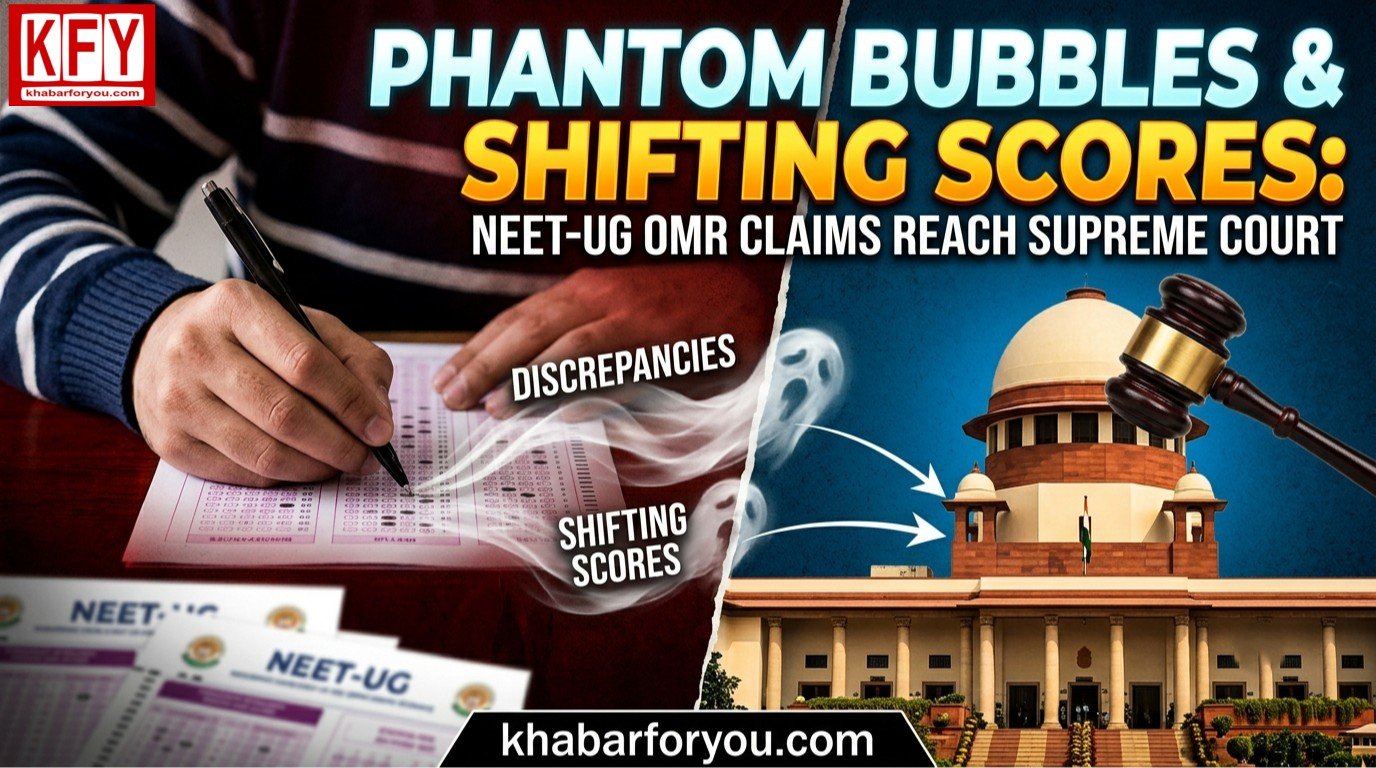
Phantom Bubbles & Shifting Scores: NEET-UG OMR Discrepancy Claims Reach Supreme Court | KhabarForYou
- The Legal LADKI
- 04 Aug, 2026
- 84737

Email:-thelegalladki@gmail.com
Instagram:-@TheLegalLadki

In what is rapidly escalating into one of the most fraught legal and institutional battles in India’s competitive examination history, a group of National Eligibility cum Entrance Test (NEET-UG) candidates has moved the Supreme Court of India, alleging unprecedented discrepancies between their physical Optical Mark Recognition (OMR) answer sheets and the digital evaluation records uploaded on the National Testing Agency (NTA) portal.
The writ petition before the apex court - backed by parallel filings in the High Courts of Delhi and Bombay - places the integrity of the country’s premier medical entrance test under an intense judicial microscope. Aspirants contend that scores displayed on the official testing portal suffered wild, unexplainable fluctuations within hours of publication, while scanned OMR images uploaded by the testing body allegedly reflect response patterns that differ fundamentally from the physical sheets filled inside examination halls.
The development arrives at a delicate moment for the NTA, which is already grappling with systemic scrutiny, legal challenges, and public anger following recent allegations of paper leaks and administrative oversights. As millions of medical aspirants await counseling schedules, the controversy has triggered a fundamental debate over the reliability of automated evaluation pipelines and the legal safeguards governing digital exam records.
Read More - The Anatomy of Productivity: 20 Systems Reshaping Modern Workplaces | Khabar For You
The Anatomy of Discrepancy: From 650 to 135 in 24 Hours
At the heart of the latest petition before the Supreme Court is a series of detailed forensic claims made by affected candidates. In one of the most alarming accounts cited in court documents, an aspirant from Maharashtra estimated his score between 620 and 640 marks after cross-referencing his remembered answers with the official answer key released by the NTA.
However, upon accessing the portal on the day results were announced, the candidate’s score initially reflected 650 marks out of 720. Merely hours later, after an involuntary system log-out, the displayed score plummeted to 500. By the following morning, the portal recorded his final score as 135 - a catastrophic collapse that effectively eliminated him from medical admission eligibility without any formal explanation or audit trail from the testing authority.
When the candidate personally approached the NTA headquarters in New Delhi to seek clarification under the Right to Information (RTI) framework, officials reportedly displayed a digital OMR image on a computer monitor. The candidate immediately disputed its authenticity, pointing out physical anomalies in signature alignment, bubble density, and roll number encoding. Officials, however, maintained that the digital record stored on their central servers was the sole binding version that would be presented in judicial proceedings.
Similar petitions filed across various high courts mirror these allegations. Petitioners contend that:
Barcode and Serial Mismatches: Scanned OMR copies made available on candidate dashboards feature corrupted or mismatched barcode headers compared to original attendance slips signed on exam day.
Ghost Marking: Unanswered questions in physical booklets allegedly appear as doubly marked or incorrectly filled options in the uploaded digital scans, triggering automated negative marking penalties.
Server-Side Render Errors: Score cards retrieved at different timestamps displayed variable raw scores, raising questions regarding database synchronization during peak web traffic.
The Defence: NTA Alleges AI Manipulation and Criminal Fabrication
The National Testing Agency has launched a forceful counter-offensive, categorically rejecting allegations of systemic evaluation errors or server-side tampering. In an official public notice and legal submissions, the agency asserted that all scores declared on the portal strictly align with the physical OMR answer sheets safely stored in secured vaults.
Crucially, the NTA has cautioned candidates against the spread of fake or digitally manipulated OMR images circulating on social media platforms. According to senior counsel representing the testing agency, forensic analysis of several documents produced by disgruntled candidates revealed that they had been altered using sophisticated image-editing tools and Artificial Intelligence (AI) software to overlay additional response marks.
The agency emphasized that the genuine OMR answer sheet of every candidate bears unique physical authentication markers - including candidate thumb impressions, dual invigilator signatures, and matching serial numbers - held on secure record. Warning of severe legal consequences, the NTA noted that the creation, submission, or dissemination of fabricated OMR sheets constitutes a cognizable offense under the Public Examinations (Prevention of Unfair Means) Act, 2024, alongside relevant sections of the Bharatiya Nyaya Sanhita (BNS) and the Information Technology Act.
Judicial Precedents: Sealed Envelopes and High Court Fines
The legal landscape surrounding these claims has already seen intense drama in state high courts, highlighting the strict judicial threshold required to prove OMR tampering.
In a recent benchmark ruling, the Aurangabad Bench of the Bombay High Court dismissed a set of petitions filed by four NEET candidates who alleged that their answer sheets had been improperly evaluated or altered. Recognizing the gravity of the charges, the division bench ordered the NTA to transport the original physical OMR sheets directly from New Delhi in sealed steel trunks for in-camera verification.
Upon physical inspection by the bench in the presence of the candidates, their parents, and legal representatives, the court found that the marks recorded on the physical OMR sheets matched the results declared by the NTA precisely. Concluding that the claims were backed by fabricated documents, the High Court dismissed the pleas and imposed exemplary costs of ₹5,000 on each petitioner to deter frivolous litigation that threatens to stall national admission cycles.
However, legal representatives for the new petitioners before the Supreme Court argue that isolated cases of fraudulent claims should not be weaponized to shut the door on genuine technical grievances. Advocates point out that server glitches, optical scanner miscalibrations, and digital image compression artifacts represent real technological failure modes that demand independent forensic examination rather than outright administrative denial.
Institutional Crisis & The Urgent Call for Structural Reforms
The recurring legal friction around NEET-UG points to a broader crisis of trust in India's high-stakes educational testing apparatus. With over two million candidates competing for fewer than 100,000 undergraduate medical seats, even a two-mark discrepancy can alter a student's rank by thousands of positions, determining whether they secure a government medical college seat or face financial extortion in private institutions.
Educational policy experts and legal scholars advocate for immediate structural reforms to restore transparency:
1.Chain-of-Custody Digital Ledger: Implementation of cryptographic hashing or blockchain timestamps for uploaded OMR sheets immediately after the examination concludes, preventing post-hoc server modifications or claims of alteration.
2. Carbon-Copy Carbon Retention: Providing every candidate with a high-grade physical carbon copy of their marked OMR sheet at the end of the exam, serving as an immutable physical reference document.
3. Independent Ombudsman & Audit: Establishing a statutory, independent technical ombudsman equipped with computer science and optical scanning experts to audit portal glitches and re-verify disputed sheets within 72 hours.
What Lies Ahead at the Supreme Court
As the apex court prepares to take up the petition, all eyes are on whether the court will order a independent, court-monitored forensic audit of the central database logs and physical answer sheets.
The legal outcome will carry profound implications not only for the current academic session but for the future of computer-evaluated national examinations in India. For millions of young aspirants across the country, the fight is no longer merely about individual scores - it is about ensuring that the machinery evaluating their future operates with absolute, unquestioned integrity.
© 2023 Khabar For You. All Rights Reserved.
Business, Sports, Lifestyle ,Politics ,Entertainment ,Technology ,National ,World ,Travel ,Editorial and Article में सबसे बड़ी समाचार कहानियों के शीर्ष पर बने रहने के लिए, हमारे subscriber-to-our-newsletter khabarforyou.com पर बॉटम लाइन पर साइन अप करें। |
| यदि आपके या आपके किसी जानने वाले के पास प्रकाशित करने के लिए कोई समाचार है, तो इस हेल्पलाइन पर कॉल करें या व्हाट्सअप करें: 8502024040 |
#KFY #KFYNEWS #KHABARFORYOU #WORLDNEWS
नवीनतम PODCAST सुनें, केवल The FM Yours पर
Click for more trending Khabar
Leave a Reply
Your email address will not be published. Required fields are marked *
Search
Category