US-Iran War: Pakistan to Mediate Peace? Trump Signals 'Islamabad Summit'
- Khabar Editor
- 25 Mar, 2026
- 97734
Email:-infokhabarforyou@gmail.com
Instagram:-@khabar_for_you


ISLAMABAD/WASHINGTON - In a dramatic pivot that has sent shockwaves through global energy markets and shifted the landscape of the four-week-old Iran-US war, Pakistan has emerged as the central stage for a potential high-stakes diplomatic breakthrough.
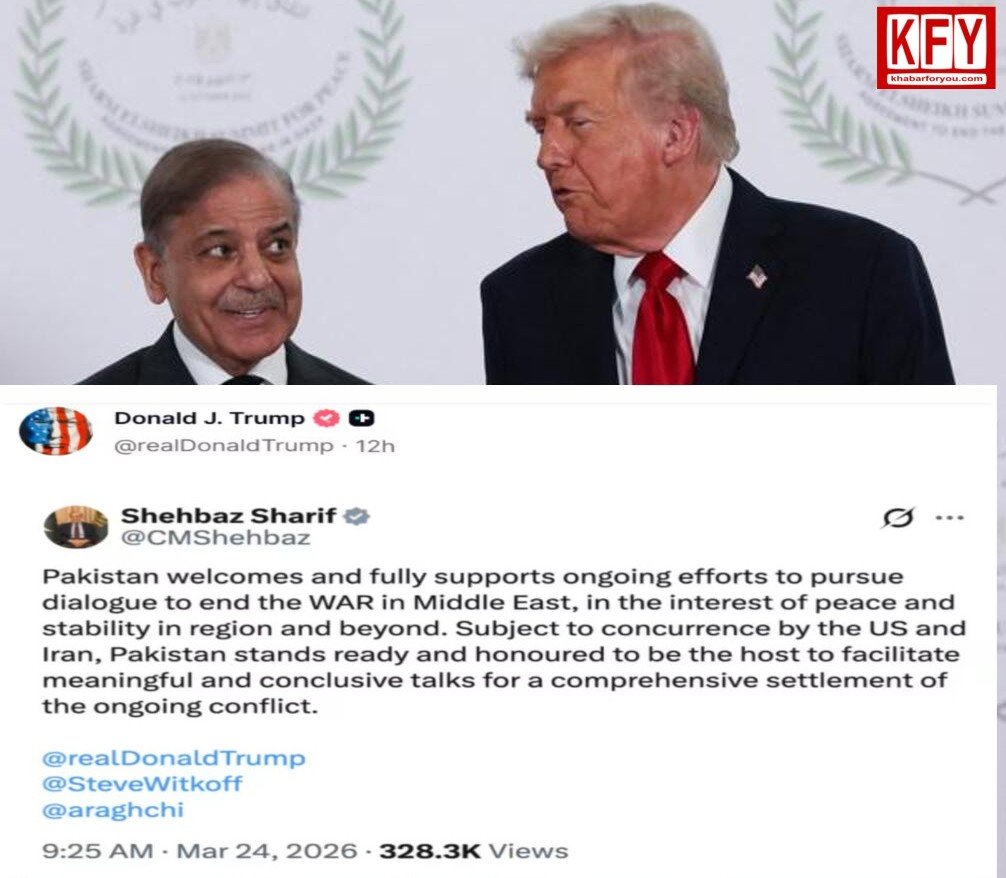
On Tuesday, Prime Minister Shehbaz Sharif formally offered Islamabad as a venue for "meaningful and conclusive talks" to end the hostilities. The proposal gained immediate, albeit unconventional, legitimacy when U.S. President Donald Trump shared a screenshot of Sharif’s invitation on his Truth Social account, signaling a major departure from his earlier "total victory" rhetoric.
Read More - PM Modi’s Iran-Israel War Warning: Why He Compared the Conflict to COVID-19? | Khabar For You

The "Islamabad Summit": A 15-Point Path to Peace?
Sources familiar with the backchannel negotiations suggest that the Trump administration has already transmitted a comprehensive 15-point peace plan to Tehran through Pakistani intermediaries. The proposal reportedly includes stringent new limits on Iran’s nuclear program and the immediate reopening of the Strait of Hormuz in exchange for a cessation of hostilities and limited sanctions relief.
In a move that underscores the seriousness of the initiative, reports from Axios and Financial Times indicate that a high-level U.S. delegation could arrive in Islamabad as early as this week. The delegation is expected to include Vice President JD Vance, special envoy Steve Witkoff, and Jared Kushner.
The Military-Political Pincer Move
The diplomatic surge follows months of "shuttle diplomacy" by Pakistan’s military leadership. Army Chief General Asim Munir, described by some as "Trump’s favorite Field Marshal," reportedly held a crucial phone call with the U.S. President on Sunday. This was followed by Prime Minister Sharif’s direct conversation with Iranian President Masoud Pezeshkian on Monday.
"Pakistan has unusual credibility here," says Adam Weinstein of the Quincy Institute. "It maintains a workable relationship with Washington while serving as the de facto diplomatic mission for Tehran in the U.S. since 1979."
Regional Repercussions and "Gunboat Diplomacy"
The prospect of talks has already cooled a boiling global economy. Brent crude oil, which had surged past $103 per barrel, plummeted by nearly 6% to $98 as news of the potential ceasefire broke.
However, the path to peace remains fraught with "blood and iron" realities:
Israel’s Stance: Even as the U.S. signaled a five-day pause in strikes on Iranian energy infrastructure, Israeli Defense Minister Israel Katz insisted the campaign against Iranian assets would continue "at full intensity." Prime Minister Benjamin Netanyahu has reportedly tasked Ron Dermer with monitoring the U.S.-Iran talks to ensure Israeli security interests are not sidelined.
Iranian Defiance: While the Iranian Foreign Ministry acknowledged receiving messages via "friendly states," Tehran’s public posture remains one of resistance. Some Iranian officials have expressed a preference for negotiating only with JD Vance, viewing other Trump envoys as less "productive."
The Nuclear Red Line: President Trump, speaking Tuesday, reiterated his core demand: "It all starts with they cannot have a nuclear weapon. They want to make a deal so badly, you have no idea."
Domestic Friction: The "Universal Joke"
In India, the development has sparked a sharp political divide. Prime Minister Narendra Modi confirmed a "useful exchange of views" with President Trump, emphasizing the need to keep the Strait of Hormuz open. However, Opposition leader Rahul Gandhi criticized the government’s stance, labeling the reliance on Pakistan as a mediator a "universal joke" and a failure of India’s strategic autonomy.
The Road Ahead
As the 82nd Airborne remains on short-notice deployment to the region, the world’s eyes are fixed on Islamabad. If Pakistan succeeds in brokering even a temporary truce, it would mark its most significant diplomatic achievement since facilitating the 1972 opening of China to the United States.
For now, the "Islamabad Summit" remains a fragile hope. White House Press Secretary Karoline Leavitt cautioned that the situation is "fluid" and that the U.S. will not "negotiate through the press." Yet, the digital nod from Trump to Sharif suggests that the "Art of the Deal" is currently being written in the corridors of Pakistani power.
Timeline of the De-escalation Push:
Feb 28: War begins following US-Israeli strikes on Tehran.
March 22: Gen. Asim Munir speaks with Donald Trump.
March 23: Trump announces a 5-day pause on strikes.
March 24: PM Shehbaz Sharif invites parties to Islamabad; Trump shares the post.
March 25: Oil prices plunge; 15-point peace plan details leak.
Business, Sports, Lifestyle ,Politics ,Entertainment ,Technology ,National ,World ,Travel ,Editorial and Article में सबसे बड़ी समाचार कहानियों के शीर्ष पर बने रहने के लिए, हमारे subscriber-to-our-newsletter khabarforyou.com पर बॉटम लाइन पर साइन अप करें। |
| यदि आपके या आपके किसी जानने वाले के पास प्रकाशित करने के लिए कोई समाचार है, तो इस हेल्पलाइन पर कॉल करें या व्हाट्सअप करें: 8502024040 |
#KFY #KFYNEWS #KHABARFORYOU #WORLDNEWS
नवीनतम PODCAST सुनें, केवल The FM Yours पर
Click for more trending Khabar
Leave a Reply
Your email address will not be published. Required fields are marked *
Search
Category