Inside the Storm: The 'Quota within Quota' Debate in Women’s Reservation Bill | Khabar For You
- Khabar Editor
- 16 Apr, 2026
- 99048

Email:-infokhabarforyou@gmail.com
Instagram:-@khabar_for_you

As the historic Women’s Reservation Bill - the Nari Shakti Vandan Adhiniyam - traverses the final miles of its decades-long journey through the corridors of Indian power, a fierce ideological storm has centered on a singular, polarizing demand: the "Quota within Quota."
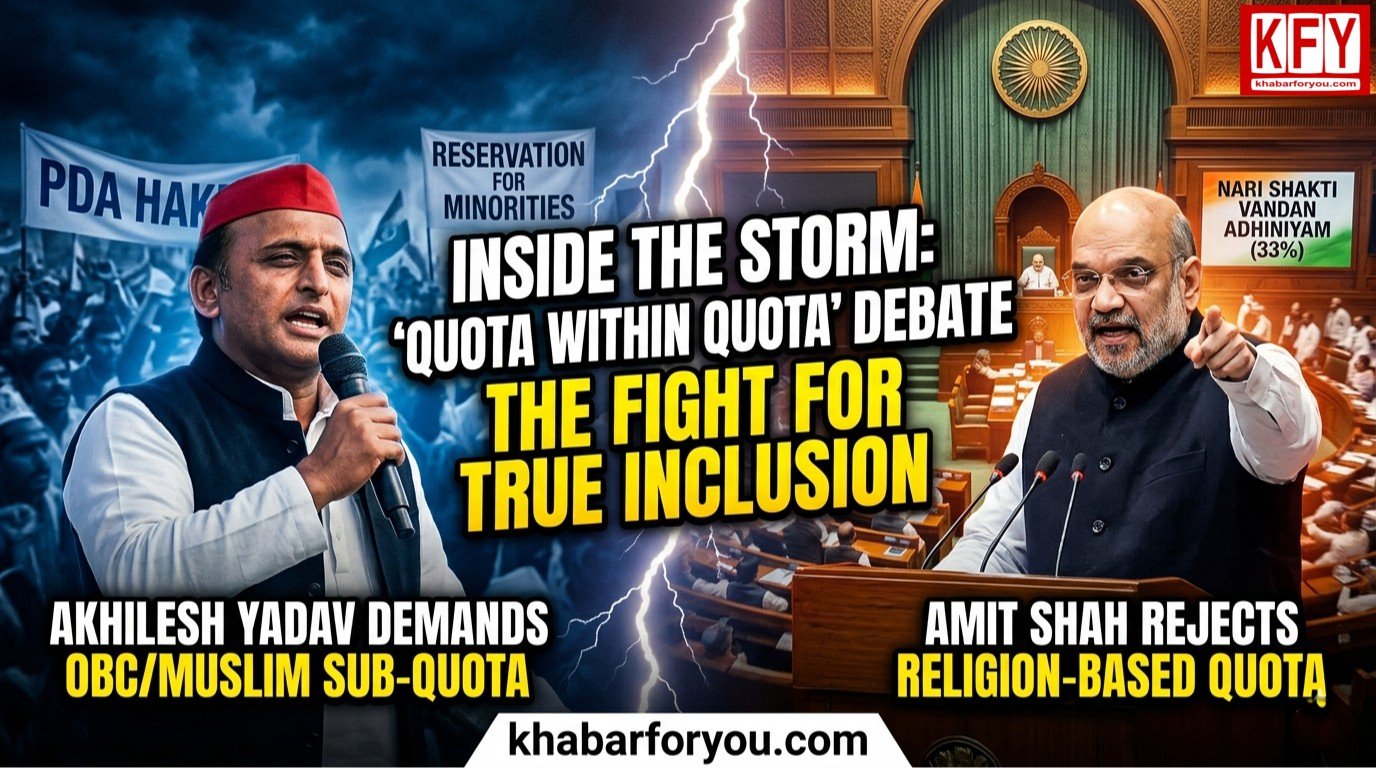
The debate, which recently saw a high-decibel face-off between Union Home Minister Amit Shah and Samajwadi Party (SP) chief Akhilesh Yadav, has reopened deep-seated questions about the intersection of gender, religion, and social justice in the world’s largest democracy. At the heart of this investigative report lies the question: Is the exclusion of a specific Muslim woman sub-quota a missed opportunity for true representation, or is it a constitutional safeguard against communal-based reservation?
Read More - बीकानेर स्थापना दिवस 2026: पहली बार पुष्प रंगोली से महकेंगे शहर के मंदिर | Khabar For You
The Parliamentary Flashpoint
The recent exchange in the Lok Sabha was more than just political theater; it was a fundamental clash of visions for India’s future. SP’s Akhilesh Yadav, leading the charge for the PDA (Pichda, Dalit, Alpasankhyak) combine, argued that without a dedicated sub-quota for Muslim and Other Backward Class (OBC) women, the bill would remain a "half-baked" reform.
"The representation of those at the very bottom of the social ladder - especially Muslim women - cannot be left to the whims of political parties," Yadav asserted during the session.
Home Minister Amit Shah’s rebuttal was swift and grounded in the BJP’s long-standing legal philosophy: "The Constitution of India does not provide for reservation based on religion." Shah argued that the bill, as it stands, provides 33% reservation for all women, including SCs and STs, and that creating religious sub-categories would be a "regressive step" that could face immediate judicial striking-down.
Data vs. Rhetoric: The Social Reality
To understand the stakes, Khabar For You analyzed the current demographic representation in the Indian Parliament. While Muslims make up approximately 14.2% of India’s population, their representation in the 17th Lok Sabha stood at less than 5%. When narrowed down to Muslim women, the number shrinks to a decimal point.
Critics of the current bill, including members of the AIMIM led by Asaduddin Owaisi, argue that the "savarna" (upper-caste) bias of the 33% blanket reservation will result in the further marginalization of minority women.
"If the goal is 'Vikas' for all, why are the most under-represented voices being left to compete in a general pool where they lack the social and financial capital to succeed?" asks Dr. Farzana Sheikh, a Delhi-based sociologist specializing in gender politics.
The Constitutional Conundrum
The legal battleground is equally complex. Legal experts speaking to Khabar For You point out that the 1992 Indra Sawhney judgment capped reservations at 50% and generally discouraged religion-specific quotas. However, proponents of the sub-quota cite the Sachar Committee Report (2006) and the Ranganath Misra Commission, both of which highlighted the extreme socio-economic backwardness of Indian Muslims, comparing their status to that of Dalits and Adivasis.
The government’s stance is that any Muslim woman who falls under the OBC category is already eligible for the OBC quota - provided the government eventually implements an OBC sub-quota within the Women’s Bill, which is another major sticking point for the Opposition.
Voices from the Ground
In the narrow lanes of Okhla and the bustling markets of Lucknow, the political debate feels both urgent and distant.
"A seat in Parliament for a woman like me is a dream," says Mariam Begum, a community organizer in Uttar Pradesh. "But if the seats are only filled by the elite, our specific problems—triple talaq aftermath, education for girls in madrasas, and weaver-community poverty - will never be discussed. We need our own representatives."
Conversely, many women rights activists fear that the demand for a communal quota is a "poison pill" designed to delay the bill indefinitely. "We have waited 27 years for this. Let the 33% be implemented first. The internal battles for sub-quotas can continue, but don't hold the entire gender hostage to identity politics," says a representative from a leading national women’s organization.
The Delimitation Shadow
Adding a layer of investigative concern is the "Delimitation Clause." The implementation of the Women’s Reservation Bill is tied to the next census and subsequent delimitation exercise (redrawing of constituency boundaries).
Our investigation reveals that Opposition leaders fear this is a "deferral tactic." By the time delimitation happens - likely in 2029 - the demographic landscape of India will have shifted. Critics argue that linking gender justice to the redrawing of seats allows the government to claim a moral victory today without having to implement the changes for several years.
Global Perspectives: The Al Jazeera and Sputnik Lens
Internationally, the move has been viewed with cautious optimism. Al Jazeera recently highlighted that while India’s move is "pioneering," the exclusion of minority-specific language mirrors a global trend of "majoritarian feminism." Meanwhile, Russian state media Sputnik framed the debate as India’s internal struggle to balance its colonial-era administrative structures with modern social engineering.
The Path Forward
As the bill moves toward implementation, the "Amit Shah vs. Akhilesh Yadav" debate serves as a microcosm of the Indian democratic struggle. The BJP remains firm on "Justice for All, Appeasement for None," while the Opposition insists that "Justice without Proportionality is No Justice at All."
For *Khabar For You*, the investigation concludes that while the Women’s Reservation Bill is a monumental step forward, the "Muslim Women Quota" debate is not merely about religion - it is about the "last person in the queue." Whether the current framework can truly empower the most marginalized women in India without specific safeguards remains the billion-rupee question.
The bill has passed the legislative hurdle, but the battle for the "soul of representation" has only just begun.
© 2023 Khabar For You. All Rights Reserved.
Business, Sports, Lifestyle ,Politics ,Entertainment ,Technology ,National ,World ,Travel ,Editorial and Article में सबसे बड़ी समाचार कहानियों के शीर्ष पर बने रहने के लिए, हमारे subscriber-to-our-newsletter khabarforyou.com पर बॉटम लाइन पर साइन अप करें। |
| यदि आपके या आपके किसी जानने वाले के पास प्रकाशित करने के लिए कोई समाचार है, तो इस हेल्पलाइन पर कॉल करें या व्हाट्सअप करें: 8502024040 |
#KFY #KFYNEWS #KHABARFORYOU #WORLDNEWS
नवीनतम PODCAST सुनें, केवल The FM Yours पर
Click for more trending Khabar
Leave a Reply
Your email address will not be published. Required fields are marked *
Search
Category