India Toll Cash Ban: NHAI Mandates FASTag & UPI from April 10 | Khabar For You
- Khabar Editor
- 06 Apr, 2026
- 97631

Email:-infokhabarforyou@gmail.com
Instagram:-@khabar_for_you


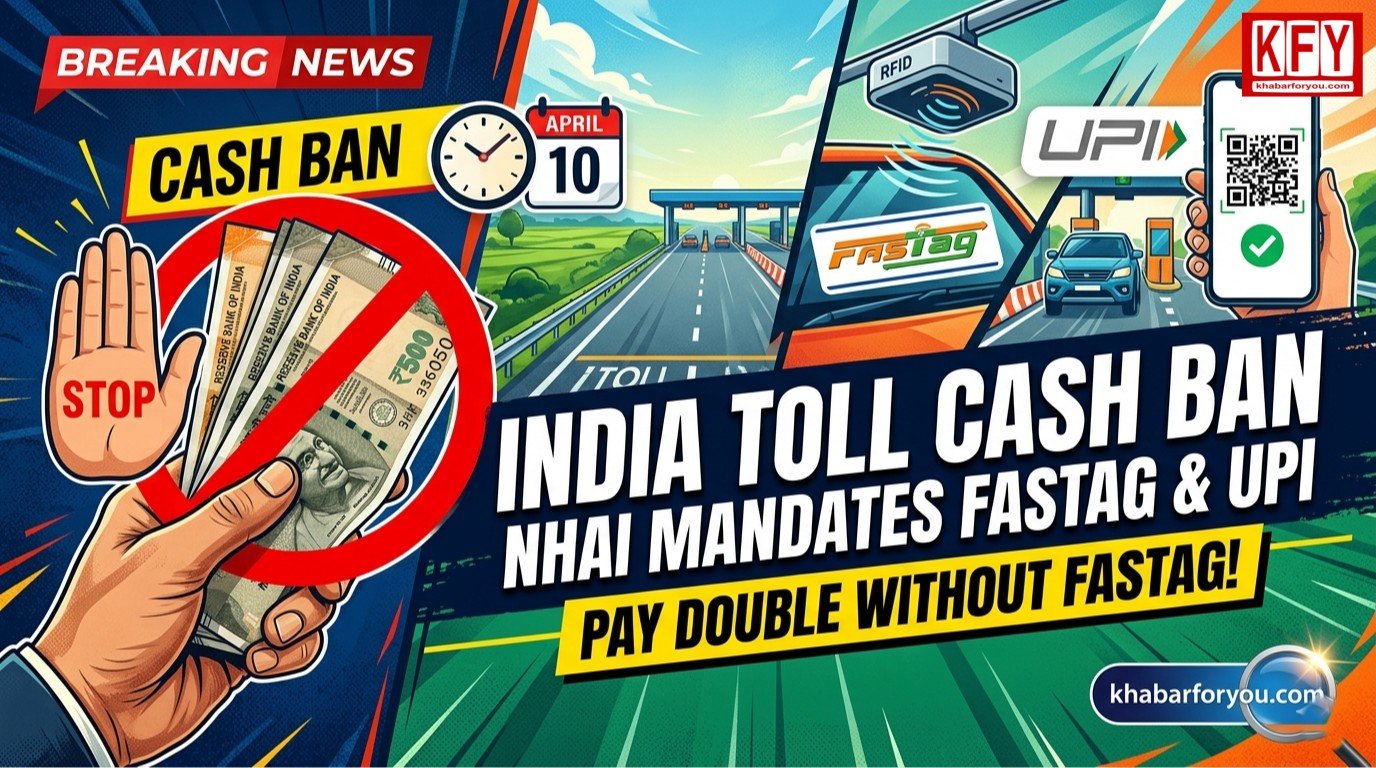
In a move aimed at eliminating the perennial bottleneck of highway congestion and digitizing India’s transit infrastructure, the National Highways Authority of India (NHAI) has announced a definitive ban on cash transactions at all National Highway toll booths across the country. Starting April 10, commuters must transition entirely to FASTag or UPI-based payments, marking the end of the "Cash Lane" era.
While the government hails this as a leap toward "Digital India," the transition raises critical questions regarding rural accessibility, technical glitches, and the fate of casual travelers. Khabar For You investigates the implications of this sweeping mandate.
Read More - 45-Day Ceasefire: Trump’s Deadline & Pakistan’s Role in Iran-Israel Peace Talks
The Mandate: Efficiency Over Currency
The Ministry of Road Transport and Highways (MoRTH) issued the directive late Tuesday, stating that any vehicle entering a toll lane without a functional FASTag or a valid UPI interface after the midnight of April 10 will be penalized. Under the National Highway Fee Rules, such vehicles will be charged double the toll amount as a "de-congestion fee," even if they offer to pay the standard rate in cash.
"Our objective is 100% electronic toll collection (ETC)," said a senior NHAI official. "Currently, cash transactions account for nearly 10-12% of delays. By removing the physical exchange of currency, we reduce the processing time per vehicle from 30 seconds to less than 4 seconds."
The Ground Reality: A Divide in Readiness
As the deadline approaches, the ground reality at major arteries like the Delhi-Gurugram Expressway and the Mumbai-Pune Expressway remains a mix of optimism and anxiety.
For regular commuters like Rajesh Kumar, a truck fleet owner, the move is welcome. "Cash was always a headache. Drivers would claim more money than spent, and change was always an issue. Digital is transparent," he told .
However, the narrative shifts in the hinterlands. In rural pockets of Uttar Pradesh and Bihar, where smartphone penetration is high but digital literacy regarding linked wallets remains spotty, the April 10 deadline feels like a "digital blockade."
"I don't travel on the highway often," says Santosh Yadav, a farmer from Jhansi. "If my FASTag balance is low and the network is down at the booth, am I expected to pay double for a system failure that isn't mine?"
The Technical Hurdle: "Blacklisted" Tags and Ghost Deductions
The investigative team found that the biggest hurdle to a "Cashless India" isn't the lack of tags, but the unreliability of the backend infrastructure. Data suggests that approximately 5-7% of FASTag users face "False Negatives" - where a tag is active and funded, but the scanner fails to read it or labels it "Blacklisted."
Under the new rules, if a scanner fails, the onus of proof lies with the driver. NHAI has promised to upgrade scanners to high-speed RFID readers, but the integration of UPI as a backup at the booth level is still in its pilot phase in many states.
Impact on Logistics and Inflation
Economists warn that while the move streamlines logistics, the "Double Penalty" system could inadvertently spike transport costs. "If 10% of trucks face technical glitches and pay double toll, that cost is eventually passed down to the consumer. In an era of fluctuating fuel prices, this is an added pressure point on the supply chain," says Dr. Arvinder Singh, a logistics analyst.
On the flip side, the NHAI estimates that the move will save the exchequer nearly ₹12,000 crore annually by reducing fuel wastage at idling toll queues and preventing "leakage" (unaccounted cash) at private toll-operate-transfer (TOT) plazas.
Security and Data Privacy
With the shift to 100% digital, every movement of a vehicle across state lines is now recorded in a centralized database. Privacy advocates have raised concerns over the "surveillance" aspect of mandatory FASTags.
"The FASTag is essentially a geo-tracking tool," says a cybersecurity expert. "While it's great for crime prevention and tracking stolen vehicles, the government must ensure that this movement data is not accessible to third parties without a judicial warrant."
The "Khabar For You" Verdict
The transition to a cashless tolling system is an inevitable step in India’s modernization. It promises shorter travel times, lower carbon emissions from idling engines, and a transparent revenue model for infrastructure building.
However, for this to be a success - and not a repeat of the chaos seen during the initial FASTag rollout in 2021 - the NHAI must address three "P"s:
1. Punctuality of Tech: Scanners must work 99.9% of the time.
2. Protection: Users must not be penalized double for "bank server down" errors.
3. Penetration: Point-of-Sale (PoS) stalls for FASTag top-ups must be available every 50km for those without easy internet access.
As April 10 nears, the highways of India stand at a crossroads between traditional commerce and a digital future. Whether this leads to a smooth ride or a digital bottleneck remains to be seen.
Business, Sports, Lifestyle ,Politics ,Entertainment ,Technology ,National ,World ,Travel ,Editorial and Article में सबसे बड़ी समाचार कहानियों के शीर्ष पर बने रहने के लिए, हमारे subscriber-to-our-newsletter khabarforyou.com पर बॉटम लाइन पर साइन अप करें। |
| यदि आपके या आपके किसी जानने वाले के पास प्रकाशित करने के लिए कोई समाचार है, तो इस हेल्पलाइन पर कॉल करें या व्हाट्सअप करें: 8502024040 |
#KFY #KFYNEWS #KHABARFORYOU #WORLDNEWS
नवीनतम PODCAST सुनें, केवल The FM Yours पर
Click for more trending Khabar
Leave a Reply
Your email address will not be published. Required fields are marked *
Search
Category